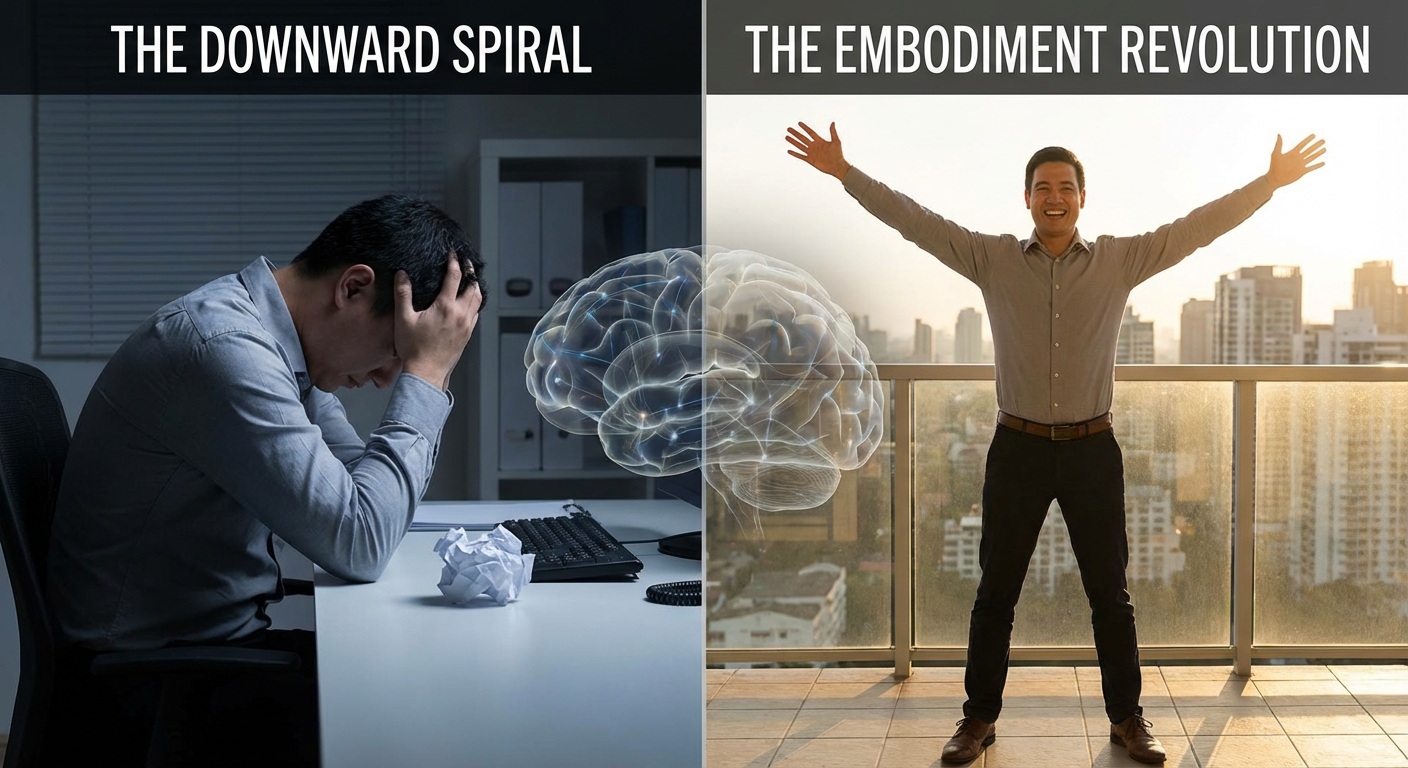
We’ve all seen it. The person who has just received bad news, their body seeming to shrink inward, shoulders rounded, head bowed. Their posture is a physical manifestation of defeat. Contrast this with the athlete who has just won a championship, arms thrown wide in a V-shape, chest expanded, chin high. This is the universal posture of victory. The connection between our emotional state and our physical form is an observable, intuitive phenomenon. But is it a one-way street? Do our feelings simply dictate our posture, or can we flip the script? Can changing our body language actually change our mind? This question is at the heart of a revolution in understanding the mind-body connection, a field where psychology and neuroscience meet to reveal that we have more power over our internal state than we ever thought possible.
The Downward Spiral: How Stress and Emotion Collapse the Body
Notice how you’re sitting right now as you read this. Are your shoulders creeping up toward your ears? Is your back hunched over your screen? Is your breathing shallow? For many of us, the default posture of modern life is one of collapse. This isn’t just a bad habit; it’s a physiological response to the chronic stressors of our environment.
When we experience stress, anxiety, or a dip in confidence—perhaps triggered by imposter syndrome or a difficult conversation—our body enters a defensive, guarded state. This is a primal, evolutionary response. Our sympathetic nervous system, the body’s “fight or flight” control panel, kicks into high gear. The muscles in our neck and shoulders (the trapezius and levator scapulae) tighten, pulling our shoulders forward and rounding our upper back into a posture known as kyphosis. Our chest may feel tight as the pectoral muscles contract, protecting our heart and vital organs. We literally make ourselves smaller, taking up less space as a subconscious strategy to appear less threatening or to shield ourselves from perceived danger.
This physical collapse creates a powerful and often vicious feedback loop to the brain. Shallow breathing, a hallmark of this stressed posture, limits oxygen intake and signals to our brain that we are in peril. The brain, receiving these cues of physical constriction and limited breath, doubles down on the feeling of anxiety or low self-worth. It confirms the narrative: “I am stressed. I am unsafe. I am not confident.” This is the core of somatic psychology—the understanding that our physical sensations and mental states are inextricably linked. Your body doesn’t just express your thoughts; it reinforces them.
The Embodiment Revolution: Faking It Until You Become It
What if you could break this cycle? What if, instead of being a passive victim of this feedback loop, you could actively intervene? This is the central premise of embodiment, the idea that our thoughts, feelings, and behaviors are grounded in our physical experiences. And no concept has brought this idea into the mainstream quite like the “power posture.”
The term was popularized by social psychologist Amy Cuddy and her colleagues in seminal research that suggested that adopting expansive, “high-power” poses for just two minutes could change our internal chemistry. The study proposed that these poses—think of the “Wonder Woman” with hands on hips or a CEO leaning back with arms behind their head—could increase levels of testosterone (the dominance and confidence hormone) and decrease levels of cortisol (the stress hormone).
While the hormonal-shift findings have faced a replication debate within the scientific community, the core behavioral effects of power posture have proven more robust. Subsequent studies and real-world application have shown that adopting an expansive posture consistently leads to feeling more powerful, confident, and assertive. The principle stands: our body can lead our mind. You can, to a certain extent, fake it until you become it. This isn’t about pretending to be someone you’re not. It’s about giving your brain the physical evidence to support a more confident and resilient version of yourself. By consciously choosing an open, expansive posture, you are sending a new message to your nervous system: “I am safe. I am capable. I am present.”
(Internal linking suggestion: This section would be a great place to link to a more detailed article on communication skills or overcoming imposter syndrome.)
Awareness is the First Step: Scanning Your Inner Landscape
Before you can change your posture, you must first become aware of it. We spend most of our days on autopilot, completely oblivious to the subtle ways tension and emotion are being held in our bodies. A body scan is a simple mindfulness practice to tune into your inner landscape.
Try this simple 3-step scan right now:
- Find Your Foundation: Whether you are sitting or standing, bring your awareness to the points of contact your body is making with the ground or your chair. Feel the soles of your feet or the weight of your body on the seat. This simple act of grounding can immediately calm a racing mind.
- Trace the Tension: Close your eyes if you feel comfortable. Mentally scan your body from your toes to the top of your head. Don’t try to change anything, just notice. Where are you holding tension? Common culprits are the jaw, the neck, the shoulders, and the belly. Do you feel a knot in your stomach? Are your shoulders hitched up by your ears? Is your brow furrowed? Acknowledge these sensations without judgment. This is simply data.
- Connect to Breath: Now, bring your attention to your breath. Is it shallow and confined to your chest, or is it deep and diaphragmatic, expanding your belly? The quality of your breath is a direct indicator of your emotional state. Notice its rhythm and depth.
This practice, performed for just a few minutes a day, builds the crucial muscle of self-awareness. It transforms your posture from an unconscious habit into a conscious choice.
The Posture Toolkit: Practical Exercises for Resetting Your State
Once you are aware of your postural habits, you can begin to actively reset them. These are not just exercises for “good posture”; they are tools for state change.
- The “Wonder Woman” Reset: This is the classic 2-minute power posture routine. Stand with your feet shoulder-width apart, place your hands firmly on your hips, lift your chest, and keep your chin level. Hold this pose for two minutes. Feel the expansiveness in your chest and the stability in your stance. Use this before a stressful meeting, a difficult conversation, or any time you need a quick boost of posture and confidence.
- Breathing into Space: Sit or stand tall. Place one hand on your belly and the other on your chest. As you inhale slowly through your nose, focus on sending the breath deep into your belly, feeling it expand like a balloon. As you exhale, gently draw your navel toward your spine. Now, try to breathe into your ribcage, feeling it expand 360 degrees—to the front, sides, and back. This diaphragmatic breathing calms the nervous system and naturally encourages the spine to lengthen.
- The Thoughtful Walk: Your walk says a lot about you. To cultivate a more confident gait, focus on these cues the next time you are walking. Walk as if you have a string pulling you up from the crown of your head, elongating your spine. Let your arms swing freely from your shoulders, not your elbows. Land on your heel and roll through your foot, pushing off from your toes. Most importantly, look forward, not at the ground. Your gaze directs your energy.
- Ergonomics of Emotion: Your workspace can either support or sabotage your posture. Adjust your environment to encourage openness. Position your monitor at eye level so your head is balanced on your spine, not jutting forward. Use a chair that supports the natural curve of your lower back. Consider a standing desk to break up long periods of sitting, which is a primary driver of postural collapse. Your workspace should be an ally in your journey toward embodied confidence.
Integrating the New You: From Pose to Persistent Presence
Power poses are a fantastic intervention, but the goal is to move beyond the 2-minute fix and cultivate a lasting, authentic embodied confidence. This is where the physical work must be integrated with the mental and emotional work. True transformation happens when your outer posture and your inner self-talk align.
As you practice these new ways of sitting, standing, and walking, pay attention to the old mental narratives that arise. The voice that says, “Who do you think you are?” or “This feels fake.” When you catch that voice, don’t fight it. Acknowledge it, and then gently redirect your focus to the physical sensation of your new posture. Feel the solidity of your feet on the ground. Feel the openness in your chest. Let the physical reality be your anchor.
Over time, this practice rewrites the feedback loop. Your brain begins to associate this new, open posture with feelings of safety, competence, and ease. The posture ceases to be a “pose” you are striking and becomes your natural way of being. This is the shift from “faking it” to embodying it. It’s a deep, internal sense of presence and self-assurance that is reflected in the way you carry yourself through the world.
Conclusion
We are not just brains carrying a body around. We are fully integrated systems, a constant dialogue between mind and matter. The language of that dialogue is written in our posture, our breath, and our movement. For too long, we’ve believed this was a one-way monologue, with our thoughts dictating our physical state. But the science of body language and psychology has shown us that we have the power to talk back. By consciously choosing to stand taller, breathe deeper, and move with intention, we are not just adjusting our bones and muscles. We are sending a powerful message to our brain, rewriting our mental and emotional story from the outside in. Your body is not a passive vessel; it is an active participant in the creation of your reality. Change your physical narrative, and you can change your world.
7-Day Embodiment Challenge
Ready to put this into practice? Try one simple task each day for the next week.
- Day 1: The Awareness Audit. Set a timer on your phone to go off three times today. When it does, stop and do the 3-step body scan. Note your posture without judgment.
- Day 2: The Morning Power-Up. Start your day with a 2-minute “Wonder Woman” Reset before you even check your phone.
- Day 3: The Mindful Walk. Take a 10-minute walk today focusing solely on the cues for a “Thoughtful Walk.”
- Day 4: The Breath Break. Instead of a coffee break, take a 5-minute “Breathing into Space” break.
- Day 5: The Ergonomic Edit. Make one adjustment to your workspace to better support an open, confident posture.
- Day 6: The Posture-Check Partner. Notice the posture of others today. See if you can compassionately observe the connection between their apparent mood and their body language. Use this as a reminder to check in with your own.
- Day 7: The Integration. Choose your favorite exercise from the week and practice it. Reflect on how you felt throughout the week. Did you notice any shifts in your mood, confidence, or energy levels?