Introduction: Why the “Trinity” is Your Key to Success
Have you ever committed to a new diet, only to feel weak and deprived? Or maybe you’ve spent hours on the treadmill, feeling fitter but not seeing the physical changes you hoped for. If you’ve tried focusing on just one thing—like only dieting or only cardio—and felt frustrated by the lack of results, you’re not alone. This is a common pitfall, and it happens because a crucial piece of the puzzle is missing.
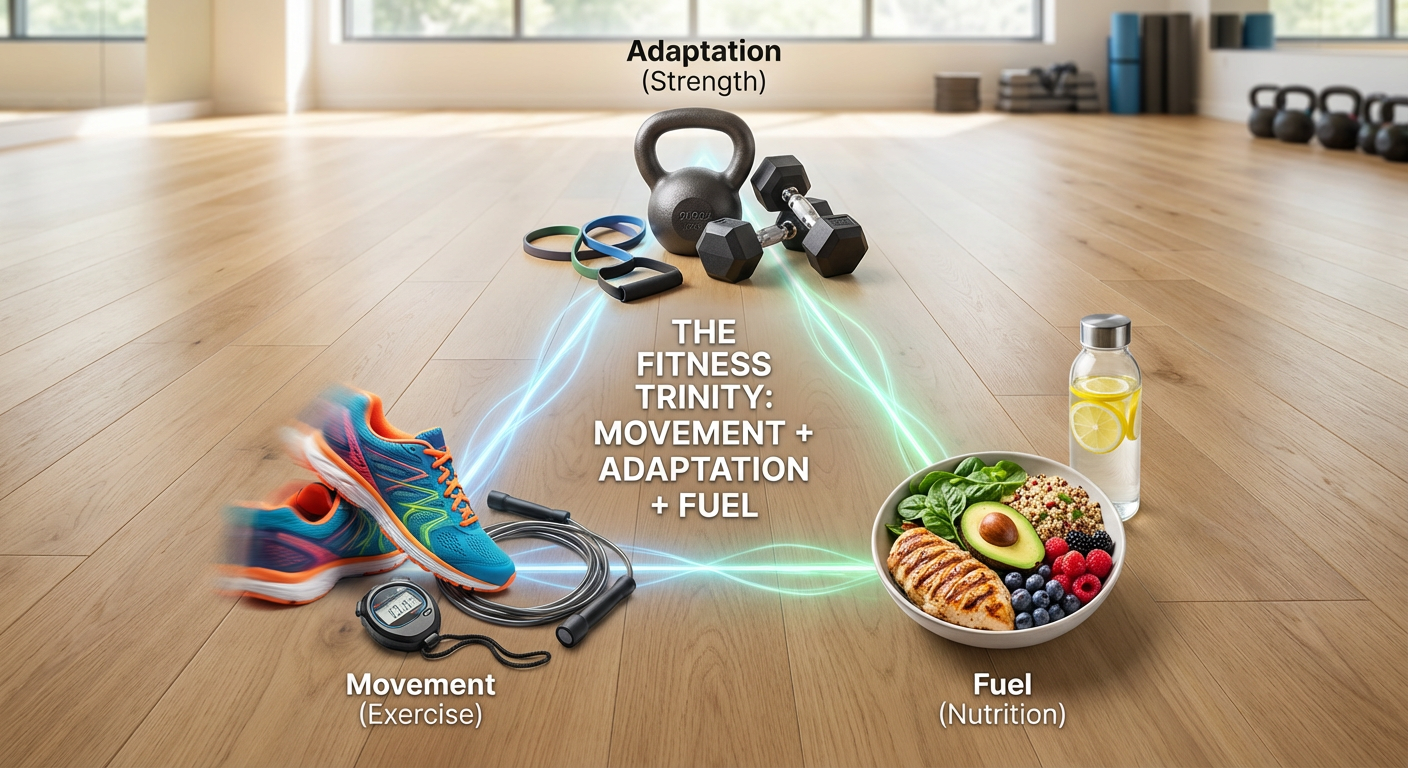
The truth is that sustainable fitness isn’t about one single effort. It’s a synergy of three interdependent elements: Movement (Exercise), Adaptation (Strength), and Fuel (Nutrition). This is the Fitness Trinity. Think of it as a three-legged stool; if you neglect one leg, the entire structure becomes wobbly and weak. To achieve lasting results and build a truly resilient body, you must embrace all three. This fitness fundamentals for beginners guide will show you how.
Pillar 1: Movement – Demystifying Exercise Types (It’s Not Just the Gym)
The first pillar is Movement, but let’s reframe it as “structured movement for a purpose.” It’s about intentionally moving your body to improve its function and health. This doesn’t mean you have to spend hours in a gym; it means finding purposeful activities that align with your goals.
Heart Health (Cardio/Conditioning)
Cardiovascular exercise, or “cardio,” is any activity that raises your heart rate and improves your circulatory system’s efficiency. Its purpose is to enhance heart and lung capacity, improve blood flow, and effectively burn calories.
- Beginner Examples: Brisk walking, cycling on a flat road, swimming, or using an elliptical machine.
- Simple Guideline: Aim for at least 150 minutes of moderate-intensity cardio per week, which could be 30 minutes, five days a week.
Building Your Frame (Strength Training)
Strength training is often misunderstood as just “bodybuilding.” In reality, its purpose is far broader: to build and maintain lean muscle, strengthen bones and connective tissues, and significantly boost your metabolism, meaning you burn more calories even at rest. A solid foundation can be built using just your body weight.
- Beginner Foundation Movements:
- Squat: To train your legs and glutes.
- Hinge: Like a deadlift, to strengthen your back and hamstrings.
- Push: A push-up (on knees or toes) for chest, shoulders, and triceps.
- Pull: A bodyweight row to work your back and biceps.
- Carry: A farmer’s walk (carrying a weight in each hand) to build core strength.
Keeping it Fluid (Mobility & Recovery)
This is the often-neglected component of movement. Mobility and recovery work is what keeps you injury-free and improves the quality of all your other movements.
- Dynamic Stretching (Pre-Workout): Gentle, movement-based stretches like leg swings and arm circles to warm up your joints.
- Static Stretching/Foam Rolling (Post-Workout): Holding stretches for 20-30 seconds or using a foam roller to release muscle tightness and improve flexibility.
Pillar 2: Adaptation – The Simple Science of Getting Stronger (Progressive Overload)
Your body is an incredibly smart and adaptive machine. It changes in response to the demands placed upon it. Strength, therefore, is not a fixed state but a skill and an adaptation. To get stronger, you must gently and consistently push your body just beyond its current comfort zone. This principle is called progressive overload explained simply.
Think of it like a savings account. If you only ever deposit the same small amount, your balance will never grow. But if you consistently add a little more, your wealth accumulates. Your strength works the same way. You must give your body a reason to build new muscle and become more resilient.
Practical Ways to Apply It (for beginners):
- Add a little more weight: Increase the resistance slightly.
- Perform more repetitions with the same weight.
- Perform more sets of an exercise.
- Improve the quality (form) of each repetition.
- Reduce rest time between sets (use this one carefully).
A crucial note on this topic: Rest is Part of Adaptation. Your muscles don’t get stronger during the workout; they get stronger during the recovery period afterward. This is why rest days and getting 7-9 hours of quality sleep are non-negotiable for progress.
Pillar 3: Fuel – Nutrition as Support, Not Punishment
The final pillar of our exercise and nutrition guide is Fuel. It’s time to stop thinking of food as a system of rewards and punishments and start seeing it for what it is: information and building materials for your body. The right nutrition supports hormone function, repairs tissue, and provides the energy needed to power you through your day and your workouts.
The Macronutrient Trio – Simplified Roles:
- Protein: The “Builder & Repair Crew.” Essential for repairing the muscle tissue broken down during exercise and for keeping you feeling full and satiated.
- Simple Sources: Chicken, fish, eggs, lentils, chickpeas, Greek yogurt, and tofu.
- Carbohydrates: The “Primary Energy Source.” This is your body’s preferred fuel for workouts and brain function. Prioritizing complex, slow-digesting carbs will provide sustained energy.
- Complex Sources: Oats, sweet potatoes, brown rice, quinoa, and fruits.
- Fats: The “Hormone Regulator & Long-Term Fuel.” Healthy fats are vital for hormone production, brain health, and the absorption of certain vitamins.
- Healthy Sources: Avocado, nuts, seeds, and olive oil.
The Golden Rule of Timing (For Beginners):
You don’t need complicated timing strategies to start. Keep it simple. Focus on having a balanced meal with carbohydrates and protein 1-2 hours before your workout. Afterward, have a similar recovery meal within 1-2 hours to replenish energy stores and kick-start the muscle repair process.
Hydration is Non-Negotiable.
Water is essential for nearly every bodily function, including performance and recovery. Even slight dehydration can negatively impact your strength, energy, and mental focus. Keep a water bottle with you all day.
Putting It All Together: Your Sample Weekly Integration Blueprint
Understanding the pillars is the first step. The next is seeing how they fit into a practical workout and diet plan for beginners. Here is a non-intimidating sample schedule that shows how to build strength and eat right.
| Day | Activity | Pillar Focus | Nutrition Focus (Pillar 3) |
|---|---|---|---|
| Mon | Full Body Strength (Squats, Push-ups, Rows, Plank) | Movement & Adaptation | Ensure a good post-workout meal with protein and carbs for recovery. |
| Tue | Active Recovery/Cardio (30-min brisk walk or light cycling) | Movement (Heart Health) | Focus on balanced meals and consistent hydration throughout the day. |
| Wed | Rest or Mobility | Adaptation (Rest) & Movement (Fluidity) | Hydration is key. Listen to your body’s hunger cues. |
| Thu | Full Body Strength (Progress!) (Repeat Mon, add 1-2 reps per set) | Adaptation (Progressive Overload) | Have a quality pre-workout meal to fuel your effort. |
| Fri | Cardio Intervals (20 mins of 1-min walk / 1-min jog) | Movement (Heart Health) | Focus on replenishing energy with complex carbohydrates. |
| Sat/Sun | Rest & Light Activity (Stretching, walk with family) | Adaptation & Movement | Relax your meal timing, but continue to make mindful choices. |
This balanced fitness routine ensures you are stimulating your body to adapt (strength days), allowing it to recover (rest/mobility days), and maintaining heart health (cardio days), all while supporting the process with proper fuel.
Common Trinity Traps & How to Avoid Them
- Trap 1: Overemphasizing one pillar. The “cardio bunny” who neglects strength, or the person who only focuses on “clean eating” without exercise, will eventually hit a wall.
- Trap 2: Not applying progressive overload. If you do the same workout with the same weight for months, your body has no reason to change. This is a common cause of strength plateaus.
- Trap 3: Neglecting fuel. Severely undereating while increasing your activity level is a recipe for burnout. Your body needs building blocks to recover and adapt.
- Trap 4: Ignoring recovery. Pushing hard every single day without rest leads to fatigue, burnout, and a higher risk of injury.
Conclusion: Your Journey with the Trinity
Mastery of your health and fitness is not about perfection. It’s about balance, consistency, and understanding how these core principles work together. By honoring the Fitness Trinity—Movement, Adaptation, and Fuel— you move away from frustrating cycles and build a truly strong, resilient, and capable body for the long term.
Your journey starts now. Don’t feel you have to do everything at once. Simply pick one actionable tip from each pillar to implement in the coming week.