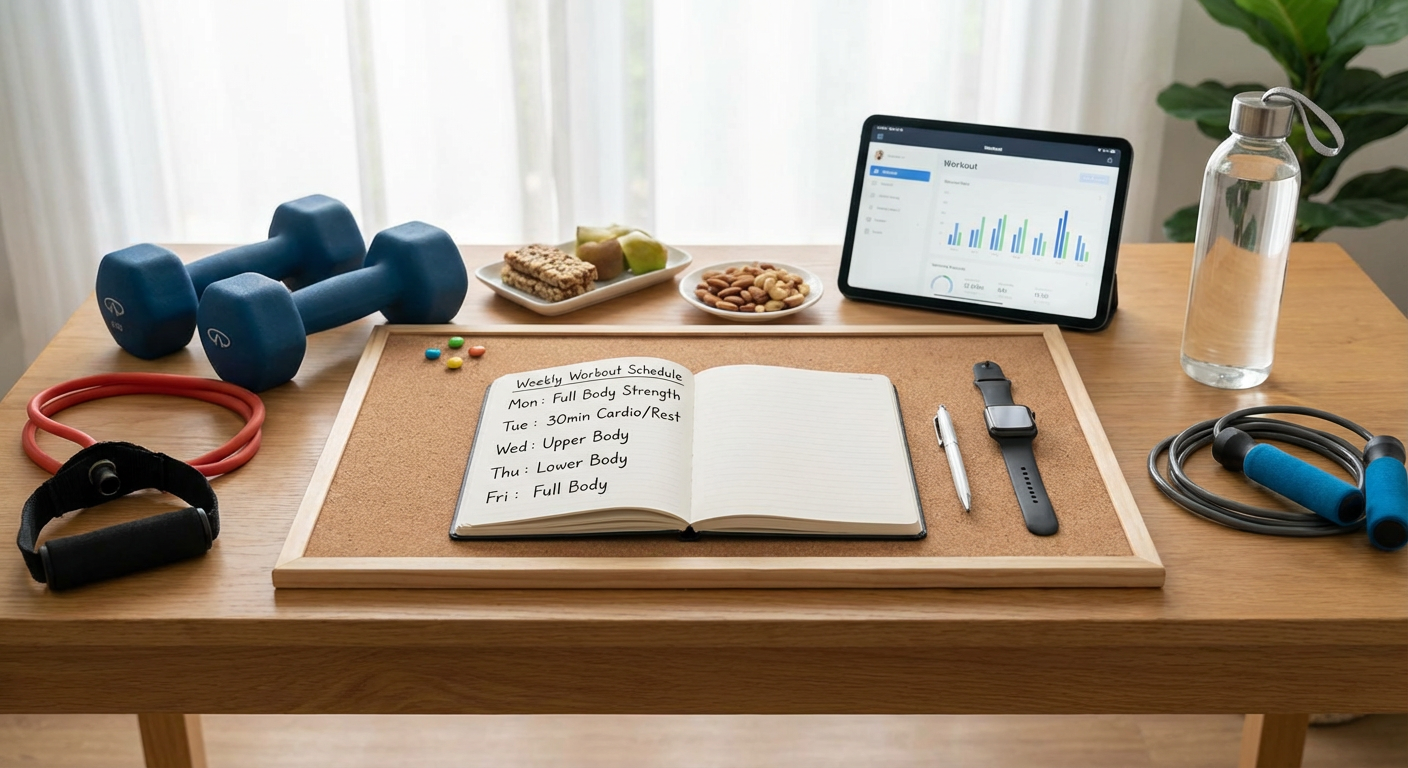
Introduction: Why Your Random Workouts Aren’t Working (And What Will)
Do you find yourself jumping from one workout video to another, trying a little of everything but committing to nothing? If you’re feeling overwhelmed, bored, or stuck on a plateau without seeing consistent progress, you’re not alone. This is the inevitable result of random, unplanned exercise.
The good news is that the solution is simpler and more powerful than you think. A planned, progressive, and balanced weekly schedule is the single most effective tool for achieving any fitness goal. It transforms exercise from just “something you do” into a system that works for you.
In this guide, we’re going to demystify the programming process. By the end, you’ll not only have a clear understanding of how it all works, but you will also possess a personalized plan you can start implementing immediately.
Step 1: The Foundation – Assess Your Life & Goals
Before we can even think about exercises, we need to build the foundation. This starts with a realistic understanding of what you can commit to and what you truly want to achieve.
The Reality Check (Time & Frequency)
Be honest with yourself. How many days per week (3, 4, or 5?) can you consistently dedicate 45-60 minutes to a workout?
The keyword here is consistently. It’s far better to commit to and nail 3 days every single week than to plan for 5, miss half of them, and feel like a failure. Remember, 3 days a week is a perfect, effective starting point.
Define Your “North Star” (Primary Goal)
Your primary goal dictates the focus of your schedule. Most fitness ambitions fall into one of three main pathways. Choose the one that best describes what you’re after:
- General Health & Fitness: You want to feel good, move better, and have more energy. Your goal is a balanced mix of strength and heart health.
- Fat Loss / Leaning Out: Your primary objective is to maximize calorie burn, boost your metabolism, and change your body composition.
- Muscle Building & Strength: Your focus is on lifting progressively heavier over time (progressive overload) and giving your muscles adequate time to recover and grow.
Once you have your number of days and your primary goal, you’re ready to pick your blueprint.
Step 2: Choose Your Workout Split (The Structural Blueprint)
A workout split is simply the “architecture” of your training week. It determines which muscles you train on which day. Here are the most effective and popular splits for beginners and intermediates.
The 3-Day Foundation: Full Body Splits
- Philosophy: You train your entire body each session. This maximizes the frequency of muscle stimulation (3x per week for each muscle), which is great for calorie burn and building a solid foundation.
- Sample Layout:
- Mon: Full Body
- Tue: Rest/Cardio
- Wed: Full Body
- Thu: Rest
- Fri: Full Body
- Sat/Sun: Active Recovery
- Best for: Beginners, time-crunched individuals, and those with general health or fat loss goals.
The 4-Day Standard: Upper/Lower Splits
- Philosophy: You divide your body into two halves: Upper Body (chest, back, shoulders, arms) and Lower Body (legs, glutes). This allows for more focus and volume per muscle group in each session.
- Sample Layout:
- Mon: Upper Body
- Tue: Lower Body
- Wed: Rest/Cardio
- Thu: Upper Body
- Fri: Lower Body
- Weekend: Active Recovery
- Best for: Intermediates, and those focusing specifically on muscle building or strength. This is a very popular and effective balanced workout split.
The 5-Day Commitment: Push/Pull/Legs (PPL) or Bro Splits
- Brief Overview: These are high-frequency, high-volume splits for dedicated enthusiasts. PPL divides days into pushing movements (chest, shoulders, triceps), pulling movements (back, biceps), and legs.
- Note: This is not recommended for true beginners. The recovery demands are high and the complexity can be overwhelming, often leading to burnout rather than progress.
Step 3: The Building Blocks – How to Fill Each Workout Day
Now that you’ve chosen your structure, it’s time to fill it with the right exercises. Every successful workout session follows a similar formula.
The Essential Components of a Session:
- Warm-up (5-10 mins): Don’t skip this! Perform dynamic moves like leg swings, cat-cow, and band pull-aparts to prepare your body for work.
- Main Compound Lifts (2-3 exercises): This is the core of your session. They target multiple muscle groups and are the most effective for progress. (e.g., Squats, Deadlifts, Bench Press, Rows).
- Accessory/Supplementary Work (2-3 exercises): These target smaller muscles or address weaknesses. (e.g., glute bridges, lateral raises, bicep curls).
- Cardio/Metabolic Finisher (Optional, 5-10 mins): Great for fat loss goals. (e.g., bike sprints, kettlebell swings, battle ropes).
- Cool-down & Stretch (5 mins): Perform static stretches for the muscles you worked to enhance flexibility and aid recovery.
Here’s how that looks in a simple template:
| Sample Full Body Day | Sample Upper Body Day |
|---|---|
| Warm-up: 5-10 mins | Warm-up: 5-10 mins |
| Compound 1: Goblet Squats (3 sets x 8-12 reps) | Compound 1 (Push): Dumbbell Bench Press (3×8-12) |
| Compound 2: Dumbbell Rows (3 sets x 8-12 reps) | Compound 2 (Pull): Pull-Ups or Lat Pulldowns (3×8-12) |
| Compound 3: Dumbbell Overhead Press (3×10-15) | Compound 3 (Push): Overhead Press (3×10-15) |
| Accessory 1: Glute Bridges (2 sets x 12-15 reps) | Accessory 1 (Pull): Single-Arm Dumbbell Rows (3×10-12) |
| Accessory 2: Plank (3 sets to failure) | Accessory 2: Lateral Raises (3×12-15) |
| Cool-down: 5 mins of stretching | Cool-down: 5 mins of stretching |
Step 4: Customize for Your Goal (The Final Tweaks)
This is where we tie it all together. Here’s how to create a workout schedule by tweaking your template based on your “North Star.”
Schedule for General Health:
- Mix: Focus on a balance of strength and cardio. For example: 2 full-body strength days, 1 dedicated cardio day (like a run or swim), and 1 “fun” activity day (like a hike or sport).
- Priority: Consistency and enjoyment. Focus on moving well and feeling strong.
Schedule for Fat Loss:
- Mix: Increase your activity frequency. A workout routine for weight loss often involves 3 full-body strength days (with metabolic finishers) plus 2-3 dedicated moderate-intensity cardio days (like brisk walking or cycling).
- Priority: Creating a consistent calorie deficit through movement. Note: The critical role of nutrition cannot be overstated here.
Schedule for Muscle & Strength:
- Mix: Focus on strength splits like Upper/Lower or PPL. A workout routine for building muscle treats cardio as strategic and low-impact (e.g., 2-3 short sessions of walking or biking) so it doesn’t interfere with recovery.
- Priority: Progressive overload on main lifts and maximizing recovery (sleep, nutrition, rest days). The rest days importance is paramount for muscle growth.
Your Interactive Plan: Build-Your-Own-Schedule Tool
Use this as your quick-start guide. Find your combination and start planning!
- If you have
3days and your goal isFat Loss, your ideal schedule is:- Day 1: Full Body Strength (with a finisher)
- Day 2: 30-min Brisk Walk or Cardio
- Day 3: Full Body Strength (with a finisher)
- Other Days: Light walking, rest.
- If you have
4days and your goal isMuscle & Strength, your ideal schedule is:- Day 1: Upper Body
- Day 2: Lower Body
- Day 3: Rest or a light walk
- Day 4: Upper Body
- Day 5: Lower Body
- Other Days: Focus on recovery and nutrition.
Pro Tips to Make Your Schedule Stick
- Schedule it in your calendar like a non-negotiable appointment.
- The 80% Rule: Aim to complete 80% of your planned workouts perfectly. Life happens; don’t quit over one missed day.
- Track Your Progress: Note the weights, reps, and how you feel. This is motivating and informs you when to progress.
- Re-assess Every 4-6 Weeks: Your body adapts, and your plan should too. Look to progress by adding weight, reps, or an extra set.
Conclusion: You Are Now the Architect
The guesswork is over. You now possess the framework to not only build your fitness plan but to adjust and adapt it as your goals and life change. You are free from the dependency on random routines.
Take this knowledge, open your calendar, and become the architect of your own fitness journey.