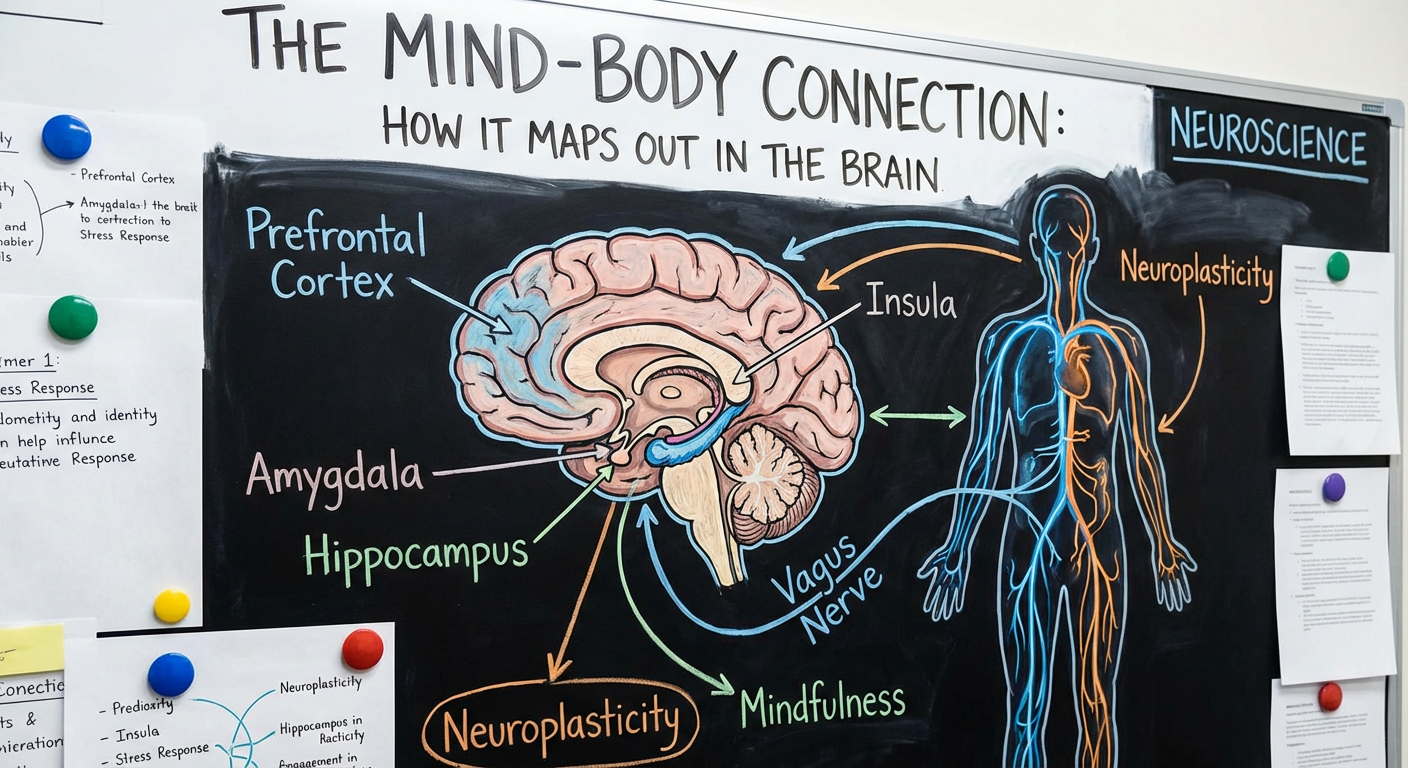
The idea that our minds and bodies are intricately connected is an ancient one, but modern neuroscience is now revealing the tangible, biological underpinnings of this relationship.
Far from being an abstract concept, the mind-body connection is a scientifically supported, two-way street where our thoughts, feelings, and beliefs can profoundly influence our physical health, and vice-versa.
This article will explore the fascinating neuroscience behind the mind-body connection, delving into how our brains serve as the master control center for this intricate dance and how we can leverage this understanding to improve our overall well-being.
The Brain’s Command Center: Mapping the Connection
Recent scientific breakthroughs have quite literally mapped the mind-body connection within the very structure of our brains.
Researchers at Washington University School of Medicine have identified a network, which they’ve dubbed the Somato-Cognitive Action Network (SCAN), that links the parts of the brain responsible for movement with networks involved in thinking, planning, and the control of involuntary bodily functions like blood pressure and heart rate.
This discovery helps to explain phenomena like why anxiety can make us want to pace, or why practices like deep breathing can calm not just the body, but the mind as well.
Several key brain regions are central to this mind-body dialogue:
- The Prefrontal Cortex: This is the brain’s executive control center, responsible for higher-order functions like decision-making, problem-solving, and regulating our behavior. It works in tandem with the limbic system to manage our emotional responses.
- The Limbic System: This collection of structures, including the amygdala and hippocampus, is the emotional core of the brain.
- The Amygdala: Often called the brain’s “fear center,” the amygdala is constantly scanning our environment for threats. When it perceives danger, it activates the “fight-or-flight” response.
- The Hippocampus: This region is crucial for learning, memory, and stress control.
- The Insula: This area of the brain is involved in self-awareness, allowing us to tune into our bodily sensations.
The Stress Response: A Case Study in the Mind-Body Connection
The body’s reaction to stress provides a powerful example of the mind-body connection in action.
When the brain perceives a threat, whether it’s a looming deadline or a physical danger, the amygdala fires up the hypothalamic-pituitary-adrenal (HPA) axis, the body’s central stress response system.
This triggers the release of hormones like cortisol and adrenaline, which prepare the body for immediate action by increasing heart rate, blood sugar, and blood flow to the muscles.
While this “fight-or-flight” response is essential for survival in the short term, chronic stress can have detrimental effects on both the brain and body.
Prolonged high levels of cortisol can:
- Shrink the prefrontal cortex, impairing our ability to learn and remember.
- Increase the size of the amygdala, making the brain more reactive to stress.
- Damage the hippocampus, which can also lead to memory problems.
- Weaken the immune system, making us more susceptible to illness.
Rewiring the Brain: Neuroplasticity and Mind-Body Therapies
The good news is that our brains are not static; they possess a remarkable ability called neuroplasticity, which means they can change and form new neural connections throughout our lives in response to our experiences.
This opens the door to a wide range of mind-body therapies that can help us actively strengthen the mind-body connection and improve our well-being.
These therapies, which focus on the interplay between the brain, mind, body, and behavior, include:
- Mindfulness and Meditation: These practices train us to pay attention to the present moment without judgment. Research has shown that regular mindfulness meditation can lead to measurable changes in the brain, including increased gray matter in areas associated with learning, memory, and emotional regulation, and a reduction in the size of the amygdala.
- Yoga and Tai Chi: These ancient practices combine physical postures, breathing exercises, and meditation to promote relaxation and bodily awareness.
- Cognitive-Behavioral Therapy (CBT): This type of therapy helps individuals identify and change negative thought patterns that can contribute to stress and other mental health issues.
- Biofeedback: This technique uses technology to help people learn to control their physiological responses, such as heart rate and muscle tension.
- Other Therapies: Other effective mind-body therapies include art therapy, music therapy, and eye movement desensitization and reprocessing (EMDR).
By engaging in these practices, we can effectively rewire our brains to be more resilient to stress, improve our emotional regulation, and foster a greater sense of overall well-being.
The Future is Integrated
The growing understanding of the profound and intricate connection between the mind and body is ushering in a new era of healthcare. It is becoming increasingly clear that mental and physical health are not separate entities, but rather two sides of the same coin.
By embracing a holistic approach that acknowledges and nurtures the mind-body connection, we can unlock our body’s innate healing potential and pave the way for a healthier and more fulfilling life.