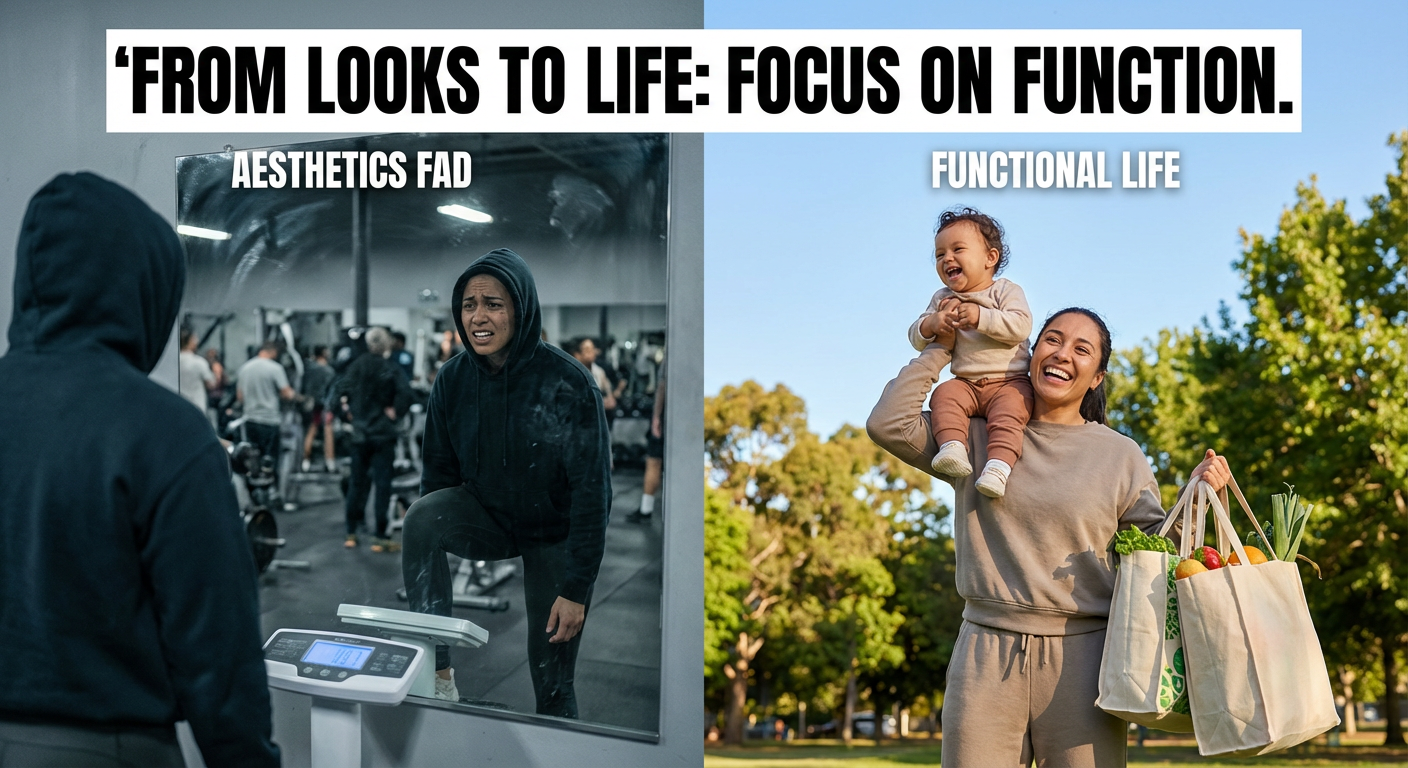
The Aesthetic Trap: Why Chasing Looks Often Leads to Burnout
Let’s be honest: a primary reason most of us start a fitness journey is to look better. We want to feel more confident in our skin, see a different number on the scale, or fit into a specific pair of jeans. There is nothing wrong with these desires. But what happens when the scale doesn’t budge for a week? What happens when you look in the mirror and, despite your hard work, you don’t see the change you were hoping for? Motivation crumbles.
This is the aesthetic trap. When our motivation is tied solely to appearance—an outcome that is fickle and often slow to change—we set ourselves up for a fragile and frustrating journey. We get caught in a cycle of punishing workouts and restrictive diets, feeling like failures when we don’t see immediate visual rewards. Burnout becomes almost inevitable.
But what if there was a better way? What if we shifted our focus from what our body looks like to what our body can do? This is the key to unlocking a more satisfying, sustainable, and ultimately more transformative path. It’s time we discuss why you should focus on function before looks in your fitness journey.
The Core Argument: Function as the Foundation, Aesthetics as the Byproduct
Think about building a house. You would never start by picking out paint colors and hanging pictures before pouring a solid concrete foundation. To do so would be to build something unstable, ready to crack at the first sign of stress. The same principle applies to your body. Functional fitness is that foundation. Aesthetics are the paint color.
Aesthetics built on a weak, dysfunctional foundation are not only fleeting but can also lead to problems down the road. By prioritizing fitness for daily life, we build a strong, resilient body from the inside out.
- Key Point 1: Aesthetic goals are outcomes, not behaviors. You can’t directly “do” a six-pack or “will” sculpted shoulders into existence. These are the results of consistent, intelligent work. What you can do is perform movements that build profound core strength and stability. You can master the behavior of a perfect push-up. The aesthetic is a byproduct of mastering the behavior.
- Key Point 2: Functional progress is rewarding every single day. You may not see a visible change in your physique overnight, but you will feel functional progress immediately. It’s the moment you carry all the groceries in one trip without your back aching. It’s playing with your kids on the floor and getting up with ease. These daily victories create powerful positive reinforcement loops that keep you motivated far more effectively than any mirror.
The “Why”: Tangible Benefits of a Function-First Approach
When you prioritize movement quality over aesthetics, the benefits extend far beyond the gym, enriching every aspect of your existence.
Injury Prevention & Longevity
Modern, sedentary life creates imbalances in our bodies. We sit for hours, which tightens our hips and weakens our glutes and core. Training the fundamental human movements—squat, hinge, push, pull, carry, and rotate—in their proper patterns does more than just build muscle. It strengthens the connective tissues, improves joint stability, and corrects these very imbalances. This is the essence of injury prevention through exercise. You are building a resilient body that can withstand the demands of life for decades to come.
Enhanced Quality of Life (The “Real World” ROI)
This is where the magic truly happens. The benefits of strength for real life are limitless and deeply personal. They manifest as:
- Lifting a heavy suitcase into the overhead bin with confidence.
- Getting up off the floor gracefully.
- Improving your posture and eliminating nagging desk-job back pain.
- Having the energy to enjoy your hobbies after a long day of work.
- Moving furniture without fear of “throwing your back out.”
These are the real returns on your investment—the quality of life exercises paying dividends daily.
Sustainable Motivation & Mental Shift
When you train for function, your motivation source shifts from extrinsic (doing it for external approval or looks) to intrinsic (doing it for the pure joy of capability). This internal drive is incredibly resilient. It doesn’t vanish when you have an “off” week or when life gets hectic. This approach fosters a deep appreciation for your body’s abilities, celebrating what it can do rather than criticizing how it looks. This is the key to long-term fitness motivation.
(The Kickback) Aesthetics Still Happen
Here’s the best part: a strong, functional, well-moving body is naturally an aesthetically pleasing body. When you focus on function, the aesthetics you were chasing often come along for the ride. The muscle definition, confident posture, and athletic look you desire are the inevitable and welcome side effects of a body that is truly fit for its purpose.
Making the Shift: Your Functional Fitness Toolkit
So, what is functional training? It’s about practicing the movements that life demands. Here are the foundational patterns and how you can start incorporating them.
The Foundational Movement Patterns
- Squat: The movement of sitting down and standing back up, or picking up something moderately heavy from a low position.
- Hinge (Deadlift): The proper way to lift a heavy object off the floor using your powerful glutes and hamstrings, protecting your spine.
- Push: Pushing open a heavy door, pushing a stalled car, or pushing yourself up from the ground.
- Pull: Opening a heavy door, starting a lawnmower, or pulling yourself up over an obstacle.
- Carry: The simple act of carrying groceries, a child, or a suitcase. It’s a full-body exercise in stability.
- Rotate & Resist Rotation: Swinging a bat or golf club, looking over your shoulder to back up a car, or, just as importantly, resisting rotation to keep your core stable and strong.
Sample “Life-Gym” Exercise Swap
- Instead of just… Leg Extensions -> Try… Goblet Squats (trains the squat pattern, core, and balance).
- Instead of just… Bicep Curls -> Try… Bent-Over Rows (trains the pull pattern, back, biceps, and posture).
- Instead of just… Crunches -> Try… Planks & Dead Bugs (trains the core to stabilize the spine, which is its primary job).
Your First Two Weeks: A Function-Focused Beginner Plan
Ready to put this into practice? Here is a simple, two-day-per-week plan that requires minimal equipment. The philosophy is to train movement patterns with a relentless focus on control and perfect form.
Perform 2-3 sets of 8-12 repetitions for each exercise, resting 60-90 seconds between sets.
- Workout A
- Goblet Squat: Functional Purpose: Makes sitting, standing, and lifting easier.
- Push-Up (or Incline Push-Up): Functional Purpose: Builds strength for pushing objects and yourself.
- Dumbbell Row: Functional Purpose: Strengthens your back for better posture and pulling power.
- Farmer’s Carry: Functional Purpose: Improves grip and core stability for carrying any heavy object.
- Plank: Functional Purpose: Develops a stable core to protect your spine in all activities.
- Workout B
- Romanian Deadlift (with light dumbbells): Functional Purpose: Teaches you to safely lift objects using your hips, not your back.
- Overhead Press: Functional Purpose: Builds strength for lifting items overhead.
- Glute Bridge: Functional Purpose: Activates your glutes to support your lower back.
- Bird-Dog: Functional Purpose: Enhances core stability and cross-body coordination.
- Side Plank: Functional Purpose: Builds lateral core strength to prevent side-bending injuries.
Balancing the Two: How to Integrate Aesthetic Goals Safely
Having aesthetic desires is perfectly natural. The goal isn’t to abandon them but to place them within a healthier, more effective framework.
Use The 80/20 Rule. Dedicate 80% of your training energy to the foundational, functional, compound movements outlined above. They provide the most significant return on investment for both performance and aesthetics. The remaining 20% can be dedicated to more isolated “accessory” work that targets specific muscles you want to develop (e.g., bicep curls, calf raises, lateral raises). This work should always come after your main functional strength work is complete.
Reframe your questions. Instead of asking, “Will this make my arms look better?” ask, “Will this exercise make me better at life and look better?” If the answer is yes, it’s a high-priority movement.
Conclusion: Redefining Your “Best Self”
For too long, we have equated fitness with a look. It’s time for a paradigm shift. True fitness is not a number on a scale or a reflection in the glass; it is the freedom to engage fully and joyfully in your life without physical limitation. It is the ability to say “yes” to adventure.
This journey is about empowerment, resilience, and longevity. It’s about appreciating your body for the incredible machine it is. And as a welcome side effect, you’ll build a great-looking body that is as capable as it is confident.